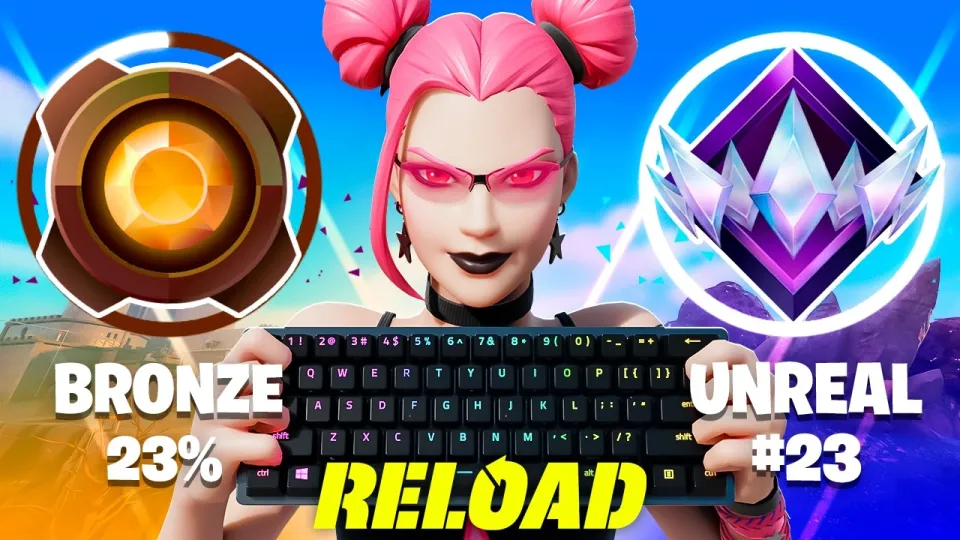
7 Steps to Go From Bronze to Unreal in Fortnite Reload Ranked
Need articles like this for your video? They help promote it on YouTube and Google — order them in the Telegram bot @sat_sit_bot. The bot writes and publishes the articles itself (with your YouTube video embedded) on popular topical websites (no ads). Try it free: 50 articles on us.
· based on the channel HaloBT
Key takeaways
- Fortnite Reload ranked runs Bronze through Unreal, and the climb is a marathon of short, high-kill matches rather than a single long grind session.
- Reload respawns mean every elimination is worth less than survival — a full team wipe is what actually ends a fight.
- Bronze and Gold lobbies punish over-aggression less than Diamond and Elite, so early ranks are the place to bank placement points.
- The creator of the speedrun, HaloBT, publishes a mechanics practice map under the Epic account linked at fortnite.com/@MoreHaloBT.
- Controller and keyboard players climb with the same rules: consistent drop spots and clean endgames beat highlight-reel clips.
Fortnite Reload ranked is a mode where squads fight on a compact map with automatic respawns until the whole team is eliminated, and the ranked ladder runs from Bronze up through Unreal. Climbing from Bronze to Unreal in Fortnite Reload comes down to seven repeatable habits: pick one drop, play for team wipes instead of solo kills, treat respawn timers as a resource, keep a reload-friendly loadout, rotate early, review your deaths, and stop queuing when tilt sets in. The speedrun format popularised by creator HaloBT shows the same principle at high speed — the ranks change, the fundamentals do not, and the practice maps he publishes through his Epic creator page are built around exactly those fundamentals.
What Fortnite Reload ranked actually rewards
Fortnite Reload condenses a battle royale into a small map with respawns, which changes what earns points. Placement still matters, but the mode rewards teams that can convert fights into full wipes, because a downed opponent who respawns is a problem you have to solve twice. In practice this means the ladder is less about surviving to the final circle and more about controlling a named location long enough that the enemy team runs out of respawns before yours does.
A few structural facts shape every climb:
- Respawn windows. Eliminated players return after a short timer as long as at least one teammate is alive, so a 2-for-1 trade is not a win unless you push the survivors immediately.
- Compact rotations. The map is small enough that third parties arrive fast; a fight that lasts longer than roughly 30 seconds usually attracts a second team.
- Ranked point buckets. Bronze through Gold award points generously for placement, while Diamond and above lean harder on eliminations and final placements.
- Solo, duo and fills all share the ladder. Queue type changes the coordination problem, not the scoring logic.
Step 1 — Lock one drop spot and learn its loot pool
Consistency beats variety in the early ranks. Choose a single named location with enough chests for a full squad, land there every match for your first 20 games, and learn the exact chest, ammo box and vehicle spawns. Bronze and Silver lobbies rarely contest the same spot twice in a row, so a mastered drop gives you a full loadout before the first fight.
Step 2 — Play for team wipes, not solo eliminations
In Fortnite Reload, a kill that does not lead to a wipe is temporary. After you knock a player, the correct follow-up is to push the remaining teammates rather than to reset, because the downed player will return. Call out respawn timers out loud if you are in fills — knowing that an enemy comes back in a few seconds changes whether you hold an angle or reposition.
Step 3 — Build a loadout that survives respawn chaos
Reload matches are ammo-hungry and fight-dense, so the loadout should favour sustain and close-range consistency. A practical priority order:
- One shotgun you can hit consistently — pump-style for damage, auto for forgiveness.
- One fast-firing mid-range weapon for finishing knocks.
- Healing, ideally a stack of small shields plus one big heal.
- Mobility or utility in the last slot, swapped for a second heal in stacked endgames.
Avoid carrying three weapons and no heals; in a mode with respawns you will take chip damage constantly and run out of shields at the worst moment.
Step 4 — Rotate before the fight ends, not after
Because the map is small, the team that arrives at a fight second usually wins it. Watch the kill feed: when two squads trade eliminations in one location, that is your cue to move. Rotating early also protects your placement points, which carry more weight in Bronze, Silver and Gold than they do in Elite and above.
Step 5 — Treat Gold as the first real filter
Gold is where the ladder stops forgiving careless pushes. Players there build faster, hold height and punish a solo push instantly, which is why Gold often feels harder than the rank above it. The fix is not more mechanics but fewer decisions: take fights you have already won positionally, and disengage from anything that requires a coin-flip 50/50.
Step 6 — Review one death per session
Improvement stalls when players only remember the highlight. After each session, open one death and answer three questions: where was the enemy team, what did I know about them, and what was the cheapest alternative play? Most ranked deaths in Reload come from missing information — an unaccounted third team or an unconfirmed respawn — rather than from bad aim.
Step 7 — Protect your queue stamina
Unreal is a volume goal, and volume collapses when you tilt. Set a rule: two losses in a row means a break, a warm-up map, or a switch to creative practice. Players who climb fastest are rarely the ones with the best mechanics; they are the ones who keep their decision quality stable across a long session.
Common questions from the ranked grind
Two themes dominate viewer questions around Reload speedruns. The first is improvement plateaus after switching input devices — the answer is structured practice on a dedicated mechanics map rather than more ranked games, because ranked matches give too few repetitions per minute. The second is whether controller or keyboard and mouse is better for the climb; both work, but controller players should lean on aim assist ranges and consistent shotgun timing, while keyboard players gain more from edit speed and precise tracking.
A third recurring question is how much the creator's own practice maps help. The maps published under the MoreHaloBT Epic account are designed for aim, edit and piece-control repetitions, which is exactly the kind of deliberate practice that transfers to Reload's short, frequent fights.
Useful links
- Creator page and practice maps: https://www.fortnite.com/@MoreHaloBT
- Community Discord: https://discord.com/invite/halobt
- Twitch streams: https://www.twitch.tv/halobt
- Twitter: https://twitter.com/halobombtrooper
- Instagram: https://www.instagram.com/therealhalobt
Final takeaway
The Bronze-to-Unreal climb in Fortnite Reload is a test of process, not talent: one drop spot, wipe-oriented fights, a sustain-heavy loadout, early rotations and controlled session length will carry most players further than any single mechanical upgrade. HaloBT's speedrun framing is useful precisely because it compresses the whole ladder into one sitting and exposes how often the same mistakes repeat at every rank. If you want to practise the pieces in isolation, grab the maps from fortnite.com/@MoreHaloBT and run a short warm-up before you queue.
Source: BRONZE To UNREAL Ranked Speedrun In Fortnite Reload! · Markdown version
Questions & answers
How long does it take to go from Bronze to Unreal in Fortnite Reload?
It depends on win rate and how many points each match returns, but a dedicated player queuing in short sessions can expect dozens of matches rather than a handful. Bronze through Gold moves quickly because placement points are generous, while Diamond and Elite require consistent top finishes and eliminations. Speedrun videos compress this into a single sitting, which is not a realistic pace for most players.
Is it easier to climb in Reload than in standard ranked battle royale?
Reload is often faster to climb because matches are shorter and respawns let you recover from an early mistake. The trade-off is that fights are more frequent, so mechanical consistency and third-party awareness matter more than long-rotation survival skills.
Should I play solo, duos or fills for the climb?
Fills and duos are usually faster if you communicate, because a coordinated team can convert knocks into full wipes. Solo removes teammate variance but punishes every mistake immediately, since there is no one to respawn you or reset a fight.
My improvement stalled after switching to keyboard and mouse — what helps?
Ranked matches give too few repetitions per minute, so the fix is deliberate practice on a mechanics map: aim routines, edit courses and piece control drills in short daily blocks. Then take that warmed-up state into ranked rather than using ranked itself as practice.